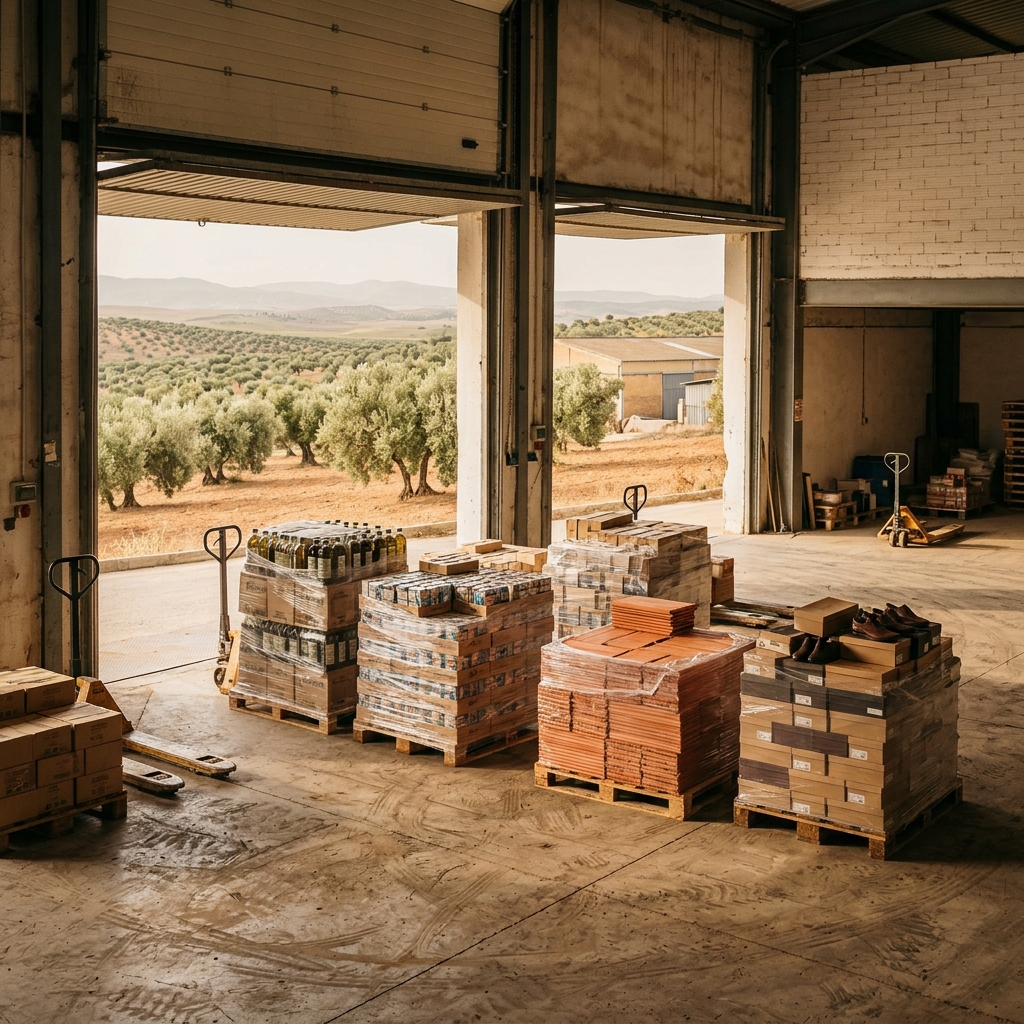
Most sourcing playbooks start and end in Shenzhen. Spain rarely makes the list, which is odd: it is the EU's second-largest country by area, a food and agriculture heavyweight, and home to manufacturing clusters for footwear, toys, ceramics, cosmetics and fashion that supply half of Europe.
The reason sellers skip it is not the product. It's discoverability. A large share of Spanish suppliers are family-owned companies with a Spanish-only website, a sales rep who answers WhatsApp faster than email, and no presence at all on Alibaba-style marketplaces. If you search in English, most of them don't exist.
This guide covers where Spanish manufacturers and distributors actually list, how to search for them, how to check a company in fifteen minutes, and what changes in logistics depending on whether you sell in the EU or in the US.
Why source from Spain at all
Spain makes sense when the "where it's from" is part of the product, or when you sell inside the EU and want short, duty-free supply lines.
Spain's strongest manufacturing clusters, by region:
Olive oil — Andalusia, and above all the province of Jaén. Spain is the world's largest olive oil producer by a wide margin.
Canned fish and seafood (conservas) — Galicia, with a long tradition of premium tinned tuna, sardines, mussels and octopus.
Cured ham and charcuterie — Salamanca (Guijuelo), Huelva (Jabugo) and Extremadura.
Wine and vinegar — La Rioja, Ribera del Duero, Catalonia, and Jerez for sherry vinegar.
Footwear — Elche and the Vinalopó valley in Alicante.
Toys — Ibi, Alicante, Spain's traditional "toy valley".
Ceramic tiles — Castellón, one of Europe's biggest tile districts.
Cosmetics and personal care — Catalonia, with a dense network of private-label labs.
Fashion and textiles — Galicia and Catalonia.
For EU sellers the case is mostly logistics and compliance. Goods move inside the single market without customs duty, a truck from Spain reaches Germany or France within days rather than weeks, and a Spanish manufacturer is an EU-established economic operator, which simplifies the "responsible person" question under the EU General Product Safety Regulation (GPSR).
For US sellers the case is the product itself: "Made in Spain" carries real weight in gourmet food, olive oil, natural cosmetics and leather goods, and Spanish suppliers are often open to small first orders that a large Asian factory would never accept.
Know who you're talking to: a short Spanish B2B glossary
Spanish suppliers describe themselves precisely, and the words matter when you search and when you negotiate.
Fabricante — manufacturer. Talk to them about private label, custom packaging and per-pallet pricing.
Distribuidor / distribuidor mayorista — distributor or wholesale distributor. Carries several brands, usually with a regional territory.
Mayorista — wholesaler. "Venta al por mayor" means wholesale; "al por menor" means retail.
Importador / exportador — importer / exporter. An exporter already knows documentation, Incoterms and pallets for international trucks.
Pedido mínimo — minimum order quantity (MOQ). "Consultar" (ask) is the normal answer on a listing.
Tarifa — price list. Ask whether it is "por caja" (per case) or "por palé" (per pallet).
Portes pagados / portes debidos — freight paid by the seller / freight paid by the buyer.
Ficha técnica — product specification sheet. Always ask for it before samples.
NIF — the company's tax ID. More on that below.
IVA — Spanish VAT: 21% standard, 10% reduced (most food), 4% super-reduced (basic staples).
Where Spanish suppliers actually list
There is no single source that covers everyone, so experienced buyers combine three or four. Here is what each one is good for.
1. A Spain-only B2B directory: MayorVenta
MayorVenta is a catalogue of Spanish manufacturers, wholesale distributors, exporters and B2B service companies, organised by category and by province. At the time of writing it lists around 4,000 suppliers across 2,719 categories, with food and beverages being by far the deepest section.
What makes it useful for a foreign buyer is the search. Instead of guessing the right Spanish category name, you describe what you need the way you would brief a sales rep — product, format, volume and region — and an AI assistant maps it to suppliers and shows where they are on a map of Spain.
We tested it with a realistic private-label request:
"Extra virgin olive oil in 500 ml glass bottles for export, about 2 pallets a month, Andalusia"
After about half a minute of reasoning, the assistant returned 79 olive oil suppliers in Andalusia, most of them tagged as exporters and wholesale distributors, with a breakdown by province: 15 in Jaén, 12 in Seville, 10 in Granada and 10 in Málaga. One click widens the same search to the whole of Spain, and another opens the full list in the catalogue with filters.
A few things we liked as buyers:
No sign-up for buyers. Every profile shows the supplier's phone, WhatsApp, email and website, and you contact them directly. There is no commission on orders and no middleman in the conversation.
Filters by supplier type. You can narrow a category to manufacturers only when you want private label, or to distributors when you want a mixed pallet from several brands.
Geography first. Browsing suppliers by province is how Spanish buyers think, and it matters for freight: a supplier near Valencia or Algeciras is a shorter haul to a container port than one in the interior.
Manual review. Listings are reviewed before publication, and the "Verified" badge means the platform has checked the supplier's phone, domain and business activity.
And the limits, so you know what you're getting:
It is a directory, not a marketplace. There is no escrow, no trade assurance and no dispute process. Payment terms and contracts are between you and the supplier, so the vetting steps below still apply.
The product lists on many profiles are taken from the supplier's own website, and the site says so. Treat them as a starting point and confirm prices, formats and availability directly.
Profiles and category names are mostly in Spanish, even though the interface has an English version. A browser translation is usually enough.
Coverage is strongest in food, hospitality equipment and consumer goods, and thinner in heavy industry.
For a seller who wants a shortlist of Spanish producers in a specific niche and region in an afternoon, it is the fastest starting point we found.
2. ICEX and the regional export agencies
ICEX España Exportación e Inversiones is Spain's public export agency. It runs sector programmes and trade missions, and its offices abroad can introduce you to exporters in a given sector. The regional agencies go deeper on their own territory: Extenda for Andalusia, IVACE for the Valencia region, ACCIÓ for Catalonia.
Best for: companies that are already exporting and want foreign buyers. Less useful for small artisan producers, who rarely appear in these programmes.
3. Trade fairs
Spanish B2B relationships are still built face to face, and a fair compresses months of emailing into two days. The ones worth knowing:
Alimentaria (Barcelona) — the big food and beverage show.
Salón Gourmets (Madrid) — premium and artisan food.
Fruit Attraction (Madrid) — fresh produce.
Cevisama (Valencia) — ceramics and bathroom.
Momad (Madrid) — fashion, footwear and accessories.
Intergift (Madrid) — gifts, home and decoration.
A practical trick: shortlist exhibitors in a directory before the fair, then book meetings in advance. Walking in cold works, but Spanish sales teams fill their calendars weeks ahead.
4. Pan-European directories
Europages and Kompass cover Spain as part of a much larger European database. They are good for larger exporters and industrial suppliers, and weaker on small producers who never bothered to fill in an English-language profile.
5. Chambers of commerce and industry associations
Every Spanish province has a Cámara de Comercio, and most sectors have an association (olive oil, canned fish, footwear, toys, cosmetics). Their member lists are public or available on request, and a short email in Spanish asking for "fabricantes que exporten" (manufacturers that export) often gets a useful answer.
How to search in Spanish (even if you don't speak it)
Use the Spanish product name. "Aceite de oliva virgen extra", "conservas de pescado", "calzado de piel", "cosmética natural", "juguetes de madera". English terms miss most results.
Add the region. Spanish suppliers think locally. "Conservas Galicia" finds more than "conservas España".
Describe the deal, not just the product. Format, packaging, monthly volume and destination tell an AI search tool or a sales rep whether you are a fit.
Write the first message in Spanish. A short, polite message translated with any modern tool gets far more replies than English. Introduce your company, the product, the volume and the destination country in five lines.
Use WhatsApp. Many Spanish B2B suppliers answer WhatsApp within hours and email within days.
Vetting a Spanish supplier in 15 minutes
Spain has good public registries, so you can check a company before you send a single euro.
Get the NIF. Every Spanish company has a tax ID (Número de Identificación Fiscal). For companies it starts with a letter: B for a limited company (S.L.), A for a public limited company (S.A.). It must be on their invoices and usually in the website's legal notice ("aviso legal").
Check the VAT number in VIES. Exporting companies are registered for intra-EU trade, and their VAT number is "ES" plus the NIF. Validate it in the European Commission's VIES database. If an "exporter" isn't in VIES, ask why.
Look them up in the commercial register. The official gazette of the Registro Mercantil, BORME, publishes incorporations, changes of directors and capital. A company founded three months ago selling "20 years of tradition" is a red flag.
Match the contact details. Phone, domain, address and company name should tell the same story. On directories with manual verification, part of this is done for you; still check it yourself for large orders.
Ask for the right paperwork. The ficha técnica for every SKU, plus certifications that matter for your category: IFS or BRCGS for food, ISO 22716 (GMP) for cosmetics, CE marking for the product types that require it.
Order samples, then a small first order. Pay attention to how the samples are packed. That is how your pallets will be packed too.
Your supplier is only half of the chain. The other half is the warehouse that receives the goods, and the same rigour applies: see our 20-point due diligence checklist for prep centers.
Negotiating MOQ, prices and payment terms
Expect "pedido mínimo: consultar". MOQs in Spain are usually negotiable, especially for a first order. Smaller producers will often accept a mixed pallet; larger ones price per full pallet or per truck.
Ask for prices on the same basis. EXW (ex works) from one supplier and delivered prices from another are not comparable. Our Incoterms guide explains which term to ask for.
Payment terms. First orders from a new foreign buyer are typically prepaid against a proforma invoice, by SEPA transfer inside the EU or by international wire. After a few orders, ask for terms. Spanish law caps commercial payment terms at 60 days, so that is the ceiling you'll hear.
Mind August. Many Spanish factories slow down sharply or close for part of August. If you need Q4 inventory, place the order before the end of July.
Getting the goods from Spain to your marketplace
If you sell in the EU
VAT. If you are VAT-registered in another EU country and give the supplier a valid VAT number, the sale is an intra-community supply: the supplier invoices without Spanish IVA and you account for VAT under the reverse charge. Without a valid EU VAT number, expect to be charged Spanish IVA.
Transport. Pallet groupage and full trucks run daily from Spain to France, Germany, Italy and Poland, typically arriving within a week.
Packaging EPR. Amazon requires EPR registration numbers for packaging in Germany and France, and in some categories elsewhere. Your Spanish supplier's registration doesn't cover you as the seller.
Prep before FBA. Spanish suppliers ship in their own export cartons, which rarely meet Amazon's labelling and packaging rules. Routing the pallets through a prep center or 3PL near the destination saves a lot of rejected shipments.
If you sell in the US
Pick the Incoterm and the port. Valencia, Barcelona and Algeciras are Spain's main container ports. Ask the supplier to quote FCA or FOB from the nearest one.
Calculate the real landed cost. Freight, duty, customs brokerage, drayage and prep can double the cost of a cheap pallet. Run it through our landed cost per unit guide before you commit.
Check the current duty rate. US tariffs on EU-origin goods changed several times in 2025. Look up the HTS code for your product and confirm the rate with your customs broker when you order, not when the container arrives.
Food and cosmetics have extra rules. Food facilities exporting to the US must be registered with the FDA, and every food shipment needs FDA Prior Notice. Cosmetics fall under MoCRA facility registration and product listing. A supplier that already exports to the US will know this; one that doesn't will need your help.
Protect the shipment. Cargo insurance and a clear payment structure matter more on a three-week ocean leg. See how to protect your cargo and your money in international shipping.
Quick checklist
Pick a product where Spanish origin is an advantage, or where you need short EU supply lines.
Build a shortlist from a Spain-specific directory such as MayorVenta, then cross-check with ICEX, trade-fair exhibitor lists and sector associations.
Search and write in Spanish, include the region, and use WhatsApp.
Verify the NIF, the VAT number in VIES and the company record in BORME.
Get the ficha técnica, certifications and samples before the first order.
Compare prices on the same Incoterm and calculate landed cost.
Plan around August, and route inventory through a prep center before it reaches Amazon.
FAQ
Do I need to speak Spanish to buy from Spanish suppliers?
No, but it helps a lot. Exporters usually have someone who speaks English; smaller producers often don't. A first message in Spanish, even machine-translated, gets noticeably more replies.
Can a non-EU business buy from Spanish wholesalers?
Yes. Exporters sell to non-EU buyers routinely, usually prepaid and on EXW or FCA terms. Some domestic distributors only sell inside Spain, so ask early: "¿Venden a empresas fuera de España?"
Is a supplier directory enough to trust a company?
No directory replaces your own checks. Manual verification of phone and domain filters out the obvious fakes, but the NIF, VIES and BORME checks above take fifteen minutes and are worth doing before any prepayment.
Which Spanish products work best for Amazon sellers?
Products where origin is part of the value — olive oil, gourmet canned seafood, natural cosmetics, leather footwear and accessories, ceramics — and, for EU sellers, consumer goods where a short, duty-free supply line beats a cheaper but slower one from Asia.