Until the end of 2025 a prep mistake was inconvenient. Amazon would fix it at the fulfillment center and bill you for the privilege. Since January 1, 2026 that safety net is gone: Amazon ended its FBA prep and labeling services on every inbound route, and a unit that arrives non-compliant is not fixed. It is refused, delayed, or received into a state you then have to argue about with Seller Support.
So the requirements stopped being a reference document and became an operating checklist. This is that checklist, in the order a unit actually moves: label it, protect it, bundle it, date it, box it, palletize it.
One caveat before the details. Amazon's requirements differ by category and by marketplace, and they change. Everything below reflects the rules as they stand at publication, but treat it as the list of things to check rather than the final authority. The binding version is always the one in your Seller Central account, under the packaging and prep requirements help pages for your category.
The five tests every unit has to pass
Before the category-specific detail, almost every rejection traces back to one of five failures:
One scannable barcode. Exactly one. Not zero, and above all not two.
The unit survives a three-foot drop onto a hard floor without the contents escaping or breaking.
Nothing can separate. A set arrives as one unit, not as parts an associate can split.
Nothing can leak, shed, or cut. Liquids, powders and sharp edges are contained.
Everything is readable. Labels flat, unobstructed, not wrapped around a corner or across a seam.
If you only remember one thing, remember the drop test. Amazon's packaging rules are largely an expression of it.
FNSKU labels: placement and the two-barcode problem
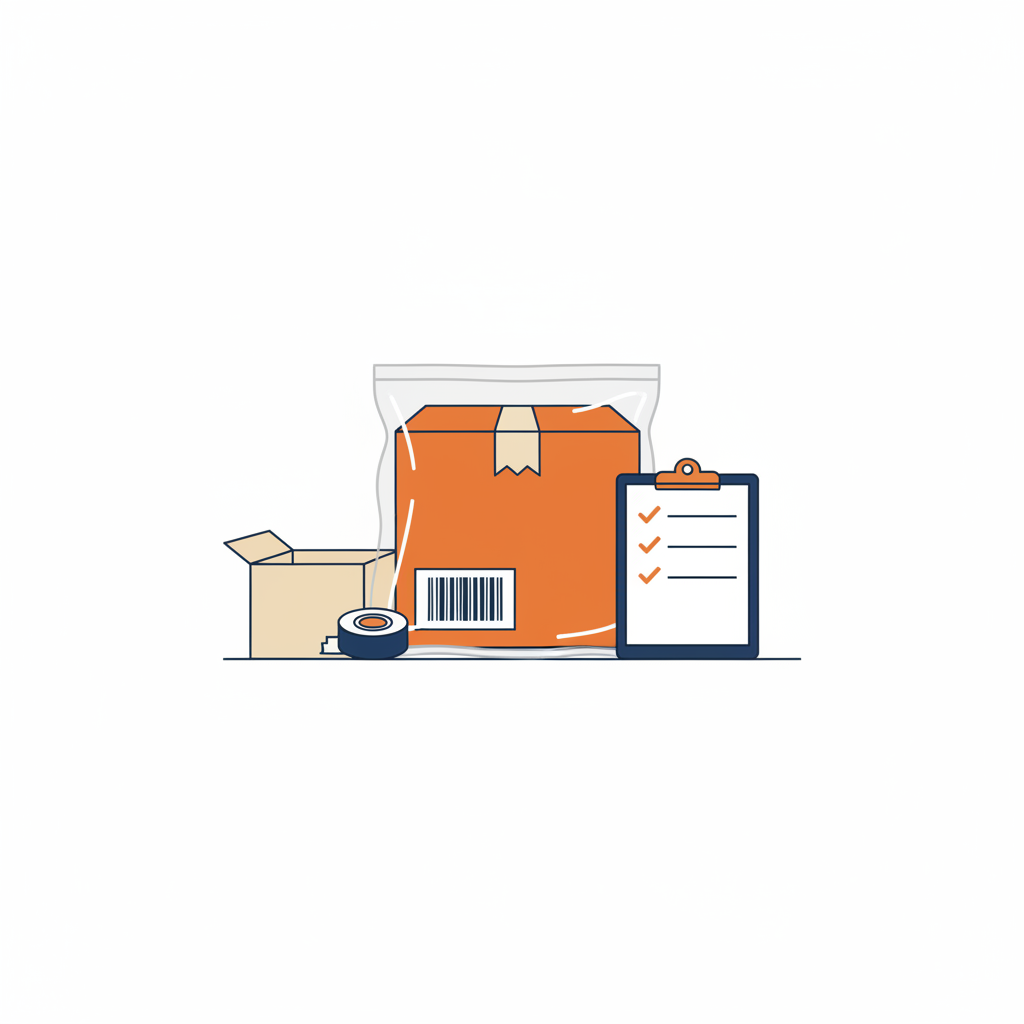
Every unit going into FBA needs a scannable FNSKU barcode unique to your seller account and listing. Print at 300 DPI or better, on a standard 1 × 2 inch or 1 × 3 inch thermal label. Inkjet on paper fades and smudges in a warehouse.
The rules that actually cause problems:
Cover the manufacturer's barcode. The FNSKU must replace or fully cover any existing UPC or EAN that a scanner can read. This is the single most common prep error, and its consequence is the worst one: your inventory gets commingled with other sellers' units of the same product, and you inherit their quality problems and counterfeits.
One live barcode per unit. If a scanner can see two, the receiving outcome is a coin flip.
Flat surface only. Not across a corner, not over a seam, not on a curved bottle where the bars distort, not over the poly bag's seal.
Do not cover anything required. Ingredient panels, safety warnings, and the suffocation warning itself must stay visible.
Label the unit a customer receives. For a multipack sold as one unit, the FNSKU goes on the outer packaging, and the inner units' barcodes must be covered.
If you are outsourcing, ask the prep center what their label error rate is and how they measure it. An operator who has never measured it does not have one. There are 468 prep centers in the catalog listing FNSKU labeling as a service.
Poly bags and suffocation warnings
Poly bagging exists to keep a product clean, contained, and in one piece. Amazon requires it for fabric and apparel, items with loose parts, small items that can be lost in a tote, powders, and anything that would be unsellable if it arrived dusty.
The specifications:
Transparent, and at least 1.5 mil thick. Thin bags tear in the tote and the unit becomes unfulfillable.
Sealed, with tape or an adhesive strip. An open bag is not a bag.
Sized to the product, with minimal loose plastic. Excess material is a snag hazard and looks like damage.
The barcode must be scannable through the bag, or applied to the outside of it.
A suffocation warning is required when the bag opening is 5 inches (12.7 cm) or more, measured with the bag flat. The warning must be permanently printed on the bag, not on a peelable sticker, and there is a minimum print size that scales with bag width.
The standard wording is the one you have seen a thousand times: a warning to keep the bag away from babies and children, and not to use it in cribs, beds, carriages or playpens.
Two traps worth naming. First, buying bags without the printed warning to save a fraction of a cent, then discovering the whole batch needs re-bagging. Second, adult products and anything with nudity or offensive imagery need opaque bagging, which is the opposite of the transparency rule everywhere else. 291 prep centers list poly bagging.
Bundles, sets and multipacks
This is where sellers lose money quietly, because the failure is invisible until a customer complains about a missing item.
A bundle has to arrive as a single unit and stay one. That means the components are physically joined, by bag, shrink wrap or box, and the outer packaging carries clear "sold as set" wording plus the single FNSKU. Every inner barcode has to be covered.
The practical points:
Shrink wrap or a sealed bag beats a rubber band or a strip of tape.
If the components are different shapes, box them. A bag around two mismatched objects fails the drop test.
Bundling is usually billed per component, not per bundle, so a three-item set costs roughly three times a single unit to prep. Model it before you build the listing.
A set that an associate can separate becomes two half-units, and neither is sellable.
170 prep centers offer two-to-three item bundling, and more offer kitting for larger assemblies.
Fragile, liquid, sharp and hazmat
Each of these has its own prep type, and they stack: a fragile glass bottle of liquid needs all three treatments.
Fragile. Bubble wrap with no exposed product, generally at least two layers, and enough that the unit survives the drop test. Corner protection for heavy or awkward items. For genuinely delicate goods, over-boxing on top of the wrap.
Liquids. Sealed so nothing escapes if the container is squeezed or dropped. In practice that means a leak-proof closure, a sealed bag, and frequently an outer box. A single leaking bottle can condemn everything around it in the tote, which is why Amazon is strict here.
Sharp. Anything that can puncture its own packaging gets wrapped, then over-boxed. The test is whether it can cut a warehouse associate reaching into a bin.
Hazmat. Batteries, aerosols, flammables, and many cosmetics fall under dangerous goods rules with their own documentation, and lithium batteries in particular have air-freight restrictions that apply long before the FBA dock. Get the safety data sheet from your supplier early — it decides whether the product can be shipped at all, not just how to pack it.
Expiration dates and lot control
If you sell anything consumable, topical or ingestible, this section decides whether your shipment is received.
Format matters. Dates must read MM-DD-YYYY or MM-YYYY. A date printed in any other format, including the day-first format most of the world uses, needs a correcting sticker applied over the original.
The date goes on both the unit and the outer carton, and the carton's version has to be large — 36-point type or bigger — so it is readable without handling.
Case packs, multipacks and display boxes all need the date on the outer packaging too.
Remaining shelf life must exceed 90 days at receipt. For a consumable, the practical bar is higher: enough time for the customer to finish the product plus 90 days. A 300-day supply of vitamins therefore needs roughly 390 days of life left.
Lot numbers are not dates. If your supplier prints only a lot code, converting it to a compliant date and labeling it is your job, before the goods ship.
Units close to expiry get removed and disposed of, so inventory planning for dated goods is a different discipline from planning for durables.
Mix lots in one carton and you lose first-expiring-first-out control, which is the point of the requirement in the first place.
Boxes, weight limits and box labels
The unit-level work is done. Now the shipment has to be buildable.
Box size: no side longer than 25 inches, except that one dimension may run to about 36 inches for longer goods. Confirm the current numbers for your case.
Weight: 50 lb per box. Heavier is allowed only when the box holds a single oversized item, and then it needs the appropriate team-lift or heavy-item marking.
Six intact sides, sufficient tape, and no reused boxes carrying old labels or markings. Strip or black out anything a scanner might read.
Adequate dunnage so nothing shifts. Air pillows, paper, or foam — not loose packing peanuts, which Amazon does not accept.
The FBA box ID label goes on a flat side, never on a seam or a corner, and never on the top if the box will be stacked. Do not place it where the tape crosses.
No "Do Not Stack" or other conflicting carrier markings unless they are genuinely required, because they change how the box is handled.
If your boxes are near a dimensional threshold, run them through the dimensional weight calculator before you commit to a case pack. Freight is priced on the greater of actual and dimensional weight, and a box that is one inch too tall can cost more to ship than the goods inside are worth.
Pallets and LTL shipments
For pallet shipments the rules tighten again:
48 × 40 inch GMA-standard pallets, four-way entry, in good condition. Broken boards get the whole shipment refused at the dock.
Maximum height around 72 inches including the pallet for a single stack, with double-stacked configurations allowed to roughly 100 inches under specific conditions.
Maximum weight in the region of 1,500 lb per pallet.
Clear stretch wrap only. Black or coloured wrap blocks the line of sight scanners need, and it is refused.
Boxes squared to the pallet edges, no overhang, heavier cartons on the bottom.
Pallet labels on all four sides, so a forklift operator can read one from any approach.
Container-loaded imports need somebody to break the container down and rebuild it to these standards. 253 prep centers list container unloading.
What non-compliance actually costs
The fee schedule is not the expensive part. The expensive parts are:
A refused or stranded shipment, which means your inventory is sitting somewhere generating no sales during the window you bought it for.
Unfulfillable inventory that has to be removed or disposed of, at your cost, plus return freight.
A suppressed listing, which loses ranking that takes far longer to rebuild than the shipment took to fix.
Commingling from an uncovered manufacturer barcode, the one error whose consequences you cannot undo.
Denied reimbursement. Damage caused by inadequate prep is your problem by definition, which is worth reading alongside what happens when a prep center loses your inventory.
A single mislabeled batch in Q4 can cost more than a year of prep fees.
Who does the work now
Three options, and the honest version of each.
Do it yourself. Workable if you are domestic, low-SKU, and under roughly 500 units a month. The cost is not labor, it is error rate and your own time. Buy the right bags with warnings pre-printed and a thermal label printer before you start.
Push it to the factory. Cheapest per unit and riskiest. Factories optimize for production, not for Amazon compliance, and a wrong barcode applied 8,000 miles away is discovered at the FC dock. If you go this way, build a verification step before the container leaves origin.
Use a prep center. Where most volume now goes. Dedicated operators do this daily, usually with photo proof at each step. Expect roughly $0.40 to $1.50 per unit depending on service level, and read what a per-unit quote really includes before you compare numbers, because receiving, storage and outbound are where the invoice actually grows.
If you are choosing an operator, work through the 20-point due diligence checklist, and decide the location deliberately — sales-tax-free states versus port states changes both your cost of goods and your freight bill. You can browse the full prep center catalog, filter to verified locations, or check who also handles Walmart WFS shipments if you sell on both channels.
If you would rather not compare listings at all, describe the job once and let matching prep centers quote it. The prep-and-send-to-FBA scenario takes about four clicks.
Frequently asked questions
Does Amazon still offer FBA prep services?
No. Amazon discontinued its FBA prep and labeling services on January 1, 2026, across every inbound route including direct shipments, AWD, Amazon Global Logistics and SEND. There is no premium tier or exception program. Units must arrive fully prepped.
When does a poly bag need a suffocation warning?
When the bag opening measures 5 inches (12.7 cm) or more with the bag laid flat. The warning must be permanently printed on the bag rather than applied as a peelable sticker, at a minimum print size that scales with the bag's width.
How thick do FBA poly bags have to be?
At least 1.5 mil, transparent, and sealed. The unit's barcode must be scannable through the bag or applied to the outside of it.
Where should the FNSKU label go?
On a flat surface of the unit's outer packaging, never across a corner or a seam, and positioned so it covers or replaces any existing scannable UPC or EAN. It must not obscure required safety or ingredient information.
What happens if the manufacturer's barcode is left uncovered?
Your units can be commingled with other sellers' inventory of the same product. You then ship goods you never sourced, inherit their defects and counterfeit risk, and cannot separate your stock afterwards. This is the prep error worth being most careful about.
What is the maximum weight of an FBA box?
50 lb for a standard box. Heavier boxes are accepted only when they contain a single oversized item, and they need the correct heavy-item or team-lift marking.
What expiration date format does Amazon require?
MM-DD-YYYY or MM-YYYY. Any other format, including day-first dates, must be covered with a correcting label. The date is required on the unit and on the outer carton in 36-point type or larger, and products need more than 90 days of remaining shelf life at receipt.
Can I use black stretch wrap on an FBA pallet?
No. Only clear stretch wrap is accepted, because scanners need line of sight to the carton labels. Pallets should carry labels on all four sides.
How much does prep cost if I outsource it?
Roughly $0.40 to $1.50 per unit for prep itself, depending on how much work each unit needs. The full invoice also includes receiving, storage, outbound and exception fees, so compare operators on blended cost per unit shipped rather than the headline rate.
Do these requirements apply to Walmart WFS as well?
The principles carry over — one scannable barcode, contained and protected goods — but the label formats and specifics differ. If you sell on both, confirm each channel separately and pick a prep center that handles both.
The short version
One barcode, and the old one covered. A sealed bag with a printed warning if the opening reaches five inches. Bundles that cannot come apart. Liquids and sharps contained. Dates in Amazon's format on the unit and the carton. Boxes under 50 lb with the label flat. Pallets clear-wrapped and square.
Everything else is category detail, and the detail is worth reading once for the products you actually sell rather than in general. Prep used to be a service you could buy at the dock. Now it is a step in your supply chain, and like every other step it works better when somebody owns it on purpose.