Every week someone asks the same question in seller groups: "Does it matter which state my prep center is in?" The honest answer is: it matters a lot for some sellers and almost not at all for others. The trick is knowing which seller you are before you start comparing quotes.
This guide walks through the two location strategies that actually move money — sales-tax-free states and states close to your supplier or port — and then shows how to pull a shortlist out of the PrepLists prep-center catalog in a few clicks instead of reading five hundred cards.
Why the state matters at all
A prep center's address changes three numbers on your P&L:
Sales tax on what you buy. If you purchase inventory at retail (Walmart, Target, Costco, brand outlets, online stores), the seller charges sales tax based on the ship-to address. Ship to a state with no sales tax and that line item disappears. If you buy wholesale with a resale certificate, this number is usually already zero and the tax-free angle does nothing for you.
Inbound freight to the prep center. A container from the Port of Los Angeles or Newark is cheap to drayage twenty miles and expensive to truck two thousand. Retail arbitrage parcels, on the other hand, ship free or nearly free to almost any US address.
Outbound freight and time to Amazon. Amazon's inbound placement service fee depends on how many locations your shipment is split across and which region it enters, and every extra day in transit is a day of stock you have to finance. The FBA calculator shows you the fee side; the prep center's location decides the transit side.
So the decision is not "which state is best" but "which of these three numbers is biggest for my business."
Strategy A: the sales-tax-free states
Five states charge no state-level sales tax: Montana, Delaware, Oregon, New Hampshire and Alaska (Alaska allows local sales taxes, and its freight costs rule it out for almost everyone). This is why a small town in Montana can host more FBA prep centers than most major cities.
Who this is for:
Retail arbitrage and online arbitrage sellers. You buy at retail price, you pay retail sales tax, and a 6–9% saving on cost of goods is often the entire margin on a flip.
Sellers without a US resale certificate, including many international sellers who cannot easily register for one.
Sellers buying from retailers that refuse resale certificates or make the exemption process painful.
Who it is not for: wholesale and private-label importers who already buy tax-exempt. For them a Montana address just adds distance.
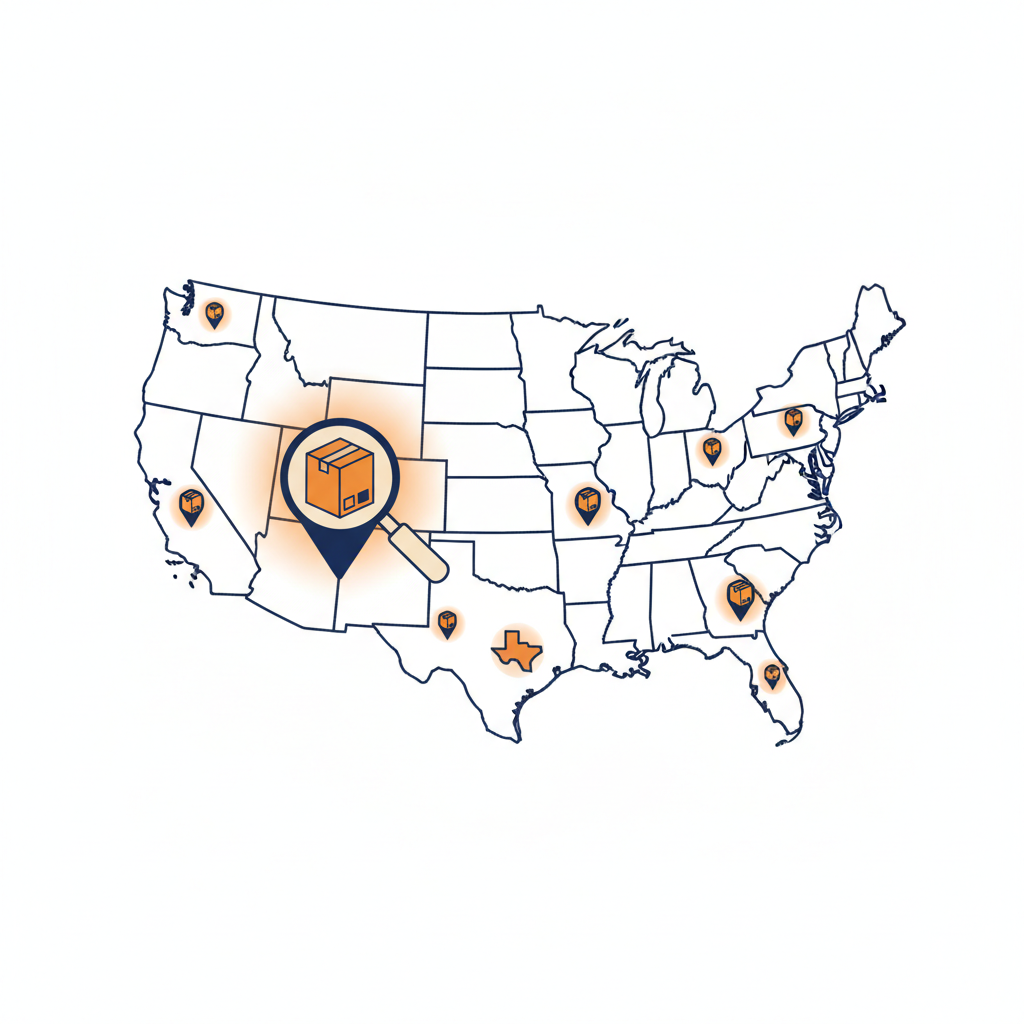
Here is what the catalog holds in each tax-free state at the time of writing:
Montana — the biggest single cluster in the catalog: 64 prep centers in Montana. Kalispell, Missoula and Billings are the usual hubs.
Delaware — 19 prep centers in Delaware. The East Coast option: tax-free and within a day's truck of the Pennsylvania and New Jersey Amazon fulfillment belt.
Oregon — 16 prep centers in Oregon. Tax-free with Portland freight infrastructure and West Coast fulfillment centers close by.
New Hampshire — 11 prep centers in New Hampshire. Small cluster, useful for sellers sourcing across New England.
A practical tip: if the tax saving is your whole reason, Delaware or Oregon often beats Montana on total cost because the outbound leg to Amazon is shorter. Montana wins on choice and on per-unit prices, which competition has pushed down. Run both through the numbers before you commit.
One caveat that belongs in every article on this topic: using a tax-free address to avoid sales tax on retail purchases is legal and common, but your own state's use-tax rules and your Amazon business address can still matter. If you are moving serious volume, ask a tax professional once. It is a cheap question.
Strategy B: near your supplier, your port, or Amazon
If you import containers or pallets, the sales tax is irrelevant and the drayage bill is everything. The states that consistently win here are the ones with ports, intermodal rail and dense Amazon fulfillment networks:
California — 40 prep centers in California. The obvious choice for anything landing at LA/Long Beach or Oakland.
New Jersey — 32 prep centers in New Jersey and 21 in New York. Port of NY/NJ, and half of Amazon's Northeast network within a few hours.
Texas — 36 prep centers in Texas. Houston port, Dallas as a rail and air hub, and a central position for sellers splitting inventory east and west.
Florida — 58 prep centers in Florida. Strong for Latin American sourcing and for Amazon's Southeast footprint.
Illinois, Georgia, Ohio, Pennsylvania — 20, 21, 12 and 10 prep centers respectively. Not port states, but they sit on top of rail hubs and the densest part of the Amazon map, which is exactly what you want when your goods are already on US soil.
Who this is for:
Wholesale importers bringing in FCL or LCL from Asia or Europe.
Private-label brands whose factory ships to a port, not a doorstep.
High-volume sellers where a one-day difference in transit to Amazon compounds across every replenishment.
If you fall in this group, pick the coast your freight lands on, then pick the state with the most Amazon fulfillment centers within a day's drive. Everything else is a rounding error.
The decision in four questions
Do you buy at retail or wholesale? Retail → tax-free state is worth real money. Wholesale with a resale certificate → skip the tax angle entirely.
How does inventory arrive? Parcels → location barely matters for inbound cost. Pallets or containers → stay near the port or rail hub.
How often do you replenish Amazon? Weekly → transit time and inbound placement fees dominate, favour central or coastal states. Monthly → distance is a smaller factor.
Do you need one prep center or two? Many mid-size sellers end up with a tax-free center for their arbitrage line and a port-state center for their wholesale line. That is not overkill; it is the normal shape of a mixed business.
How to search the catalog without reading 500 cards
The prep-center listing is filterable by URL, which means you can bookmark a shortlist rather than rebuild it every time:
By state — pick a state in the region filter, or use a link like the ones above. You can stack states:
regions=united-states-DE,united-states-NJshows both.By service — the filter matches the services a location actually lists. A search for centers offering FNSKU labeling plus shipment to Amazon FBA is the standard FBA starting point. Add
poly-bagging,bundling-2-3-itemsorcontainer-unloadingif your business needs them.Verified first — the Verified badge means the listing was created or claimed by the owner. Verified locations are the ones you can message directly with confidence that someone will answer.
Once you have three to five candidates, put them through the 20-point due diligence checklist and read the pricing guide so a "45¢ a unit" quote does not surprise you with receiving and storage fees later.
Or let the prep centers come to you
If browsing is not your thing, there is a shorter path. The quick-start page asks what you need to do — import a container, store pallets, prep and send to FBA — and turns your answer into a request that goes out to matching providers. The "Prep & send to FBA / WFS" scenario takes about four clicks: what you ship, how much, where it comes from, where it goes. Prep centers that serve that route reply with quotes, and you compare them in one inbox instead of twenty email threads.
It is also the right tool when your requirements are unusual — hazmat, oversize, a Walmart WFS and Amazon FBA split, or a state where the catalog is thin — because the request reaches providers who would not appear in a simple filter.
What to do next
Answer the four questions above and decide which strategy you are running.
Open the state links for that strategy and shortlist three to five prep centers, verified ones first.
Vet them with the due diligence checklist, and make sure you understand what happens if a prep center loses your inventory before you ship.
If you are moving off Amazon's discontinued prep service, the 2026 survival guide covers the timeline and what to hand over.
Or skip the browsing and start a request so the prep centers quote you.
Catalog counts in this article are live figures at the time of publication and will change as new locations are listed; the state links always show the current set.